
Wall Spray Foam Insulation in Arkansas
Cavity fill for open exterior walls in new construction, and injection foam for retrofitting the walls you already have closed up — here’s how each one actually works in an Arkansas house.
The short answer
Cost depends on the size, scope, and access of the job, so there is no single figure. Request an estimate and ask the participating contractor for a written quote.
Which one applies to your house comes down to one question: are the wall cavities open, or already covered in drywall or siding? Below is the full breakdown for both.
Wall Spray Foam Insulation: Cavity Fill for Open Exterior Walls
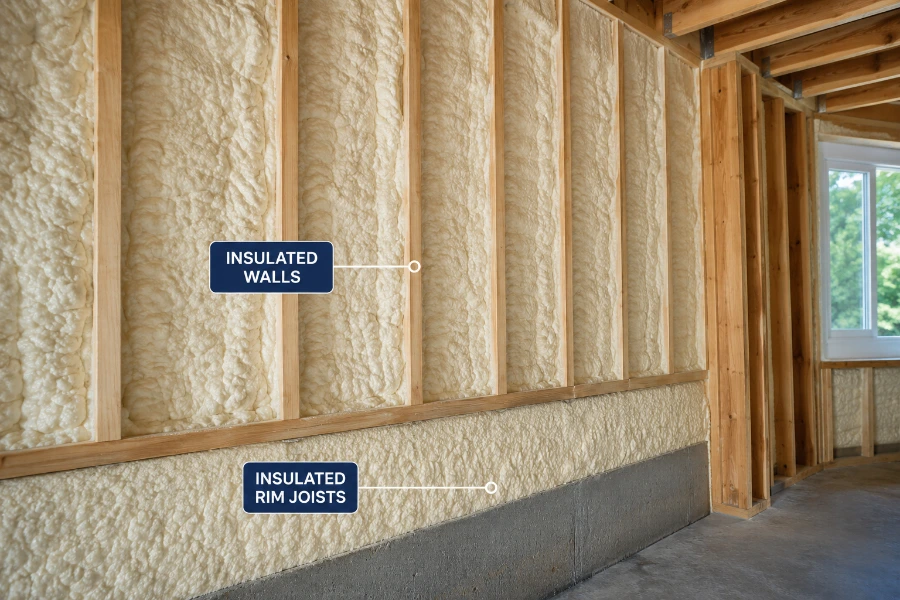
Cavity fill is the standard approach on new construction and full-gut remodels, sprayed directly into open stud bays before drywall goes up. The crew fills each cavity flush to the studs, then trims it back so the wall is ready for finish. Because the framing is exposed, there’s no guesswork about coverage — every stud bay, rim joist, and header gets foam, not just the easy-to-reach spots.
Closed-cell is the usual call for exterior walls in Arkansas’ humid climate — it acts as its own vapor retarder and adds real racking strength to the wall assembly, on top of the R-6.5–7 per inch it delivers. A standard 2×6 cavity foamed with closed-cell lands around R-21–24 finished flush; a 2×4 cavity comes in closer to R-13–15.
See our closed-cell spray foam page for the full rundown on density, vapor performance, and where it’s the right structural fit.
Retrofitting existing walls: injection foam
Most Arkansas homes weren’t built with foam in the walls, and tearing off drywall or siding just to insulate isn’t realistic for most homeowners. Injection foam solves that: a small hole is drilled into each stud bay from inside or outside, foam is pumped in under controlled pressure until the cavity is full, and the hole is patched. No demolition, no drywall repair beyond a dime-sized patch and paint touch-up.
From the exterior
Common on brick, board-and-batten, or siding that can be temporarily removed and reset per course — holes go in from outside so interior walls and paint are never touched.
From the interior
Used where exterior finish can’t be disturbed — holes go through the drywall between studs, foam fills the bay, and the patch is small enough to touch up rather than repaint the whole wall.
Injection foam is a different product from spray-applied cavity fill — it’s a low-expansion foam designed to fill an enclosed space without blowing out the drywall or siding it’s injected behind. Coverage is checked afterward with an infrared camera or moisture meter so you’re not guessing whether every bay actually got filled.
Open-cell vs. closed-cell in walls
For a neutral overview, see the U.S. Department of Energy’s guide to types of insulation.
| Factor | Open-cell | Closed-cell |
|---|---|---|
| R-value per inch | ~3.7 | ~6.5–7 |
| Vapor barrier | No — vapor-open | Yes, at ~1.5″ thick |
| 2×6 exterior wall, finished | R-13–15 | R-21–24 |
| Sound dampening | Better | Good |
| Best fit for | Interior partition walls | Exterior walls, retrofit injection |
For an exterior wall in Arkansas’ mixed-humid climate, closed-cell is almost always the better call — the built-in vapor control matters more here than in a dry climate. Open-cell still earns its place on interior partition walls, where sound dampening between rooms is the goal and vapor control isn’t a factor. See open-cell spray foam for where it fits best.
Cost by wall type
| Wall type | Typical cost | Method |
|---|---|---|
| Open cavity, new construction (closed-cell) | Varies by job — get a written estimate | Spray cavity fill |
| Open cavity, new construction (open-cell) | Varies by job — get a written estimate | Spray cavity fill |
| Existing wall retrofit (injection) | Varies by job — get a written estimate | Drill-and-fill injection |
| Average 1,500 sq ft home, all exterior walls | Varies by job — get a written estimate | Varies by method |
Retrofit injection costs more per square foot than open-cavity fill — you’re paying for the labor of drilling, patching, and verifying coverage on a wall that’s already closed up, not just for more foam. For a full breakdown across every project type, see our spray foam cost guide.
Signs your existing walls need it
Most Arkansas homes built before the 1990s have little to no cavity insulation in their exterior walls — if any of these sound familiar, injection foam is worth an on-site look:
An estimate tells you what’s actually in the walls before any drilling starts — no assumptions, no upsell based on guesswork.
Financing and 2026 rebates: the honest picture
The IRS says the federal 25C insulation tax credit does not apply to work placed in service after December 31, 2025 (IRS) — if a site still advertises it as current, treat the rest of their numbers with caution too.
What’s still worth checking for 2026:
- Entergy Arkansas Home Energy Solutions — utility-run incentives for qualifying insulation and air sealing
- SWEPCO efficiency programs, for western Arkansas territory customers
- Weatherization Assistance Program — income-qualified households, state-administered
Program terms change — confirm current numbers with your utility directly. A partner contractor can point you to third-party financing at the estimate.
Common wall insulation questions
Want to know what’s actually in your walls? Request an estimate.
Find out what’s really in your walls
Estimate requests across Arkansas, whether your walls are still open or already finished.