
Crawl Space Encapsulation in Arkansas
If your floors feel cold, your house smells musty, or you’ve seen standing water under the house, a vented crawl space is almost always the root cause. Here’s what encapsulation actually fixes, what it costs, and where it can go wrong.
The short answer
Crawl space encapsulation in Arkansas means closing off your crawl space from outside air and ground moisture — a heavy vapor barrier sealed to the walls and piers, vents closed or removed, and usually closed-cell foam sprayed on the foundation walls and rim joist. In Arkansas’s clay soil and summer humidity, a vented crawl space is a near-guarantee of condensation, and encapsulation is the standard fix. Cost depends on the job — size, foam type, thickness, access and prep — so the reliable number is a free written estimate from a partner contractor.
That’s the summary. Below is the longer version, including what most crawl space companies leave off their pitch.
Crawl Space Encapsulation Arkansas: Why Vented Crawl Spaces Fail
Vented crawl spaces were code for decades on the theory that outside air would dry the space out. In practice, in a humid climate, it does the opposite. Warm, humid summer air enters through the vents, hits the cooler soil and framing under the house, and condenses — the same way a cold glass of tea sweats on a July porch.
That condensation is what you’re smelling as “musty.” Left alone, it feeds mold on the floor joists and subfloor, corrodes ductwork and metal fasteners, and over years can lead to wood rot and sagging or cupped floors upstairs. Arkansas’s clay soil compounds it — clay holds water and drains slowly, so a vented crawl space here often sits at high humidity most of the year, not just after a rain.
Encapsulation breaks that cycle by cutting off both moisture sources at once: ground moisture (with a sealed vapor barrier) and humid outside air (by closing the vents and sealing the space).
What’s actually in a proper encapsulation job
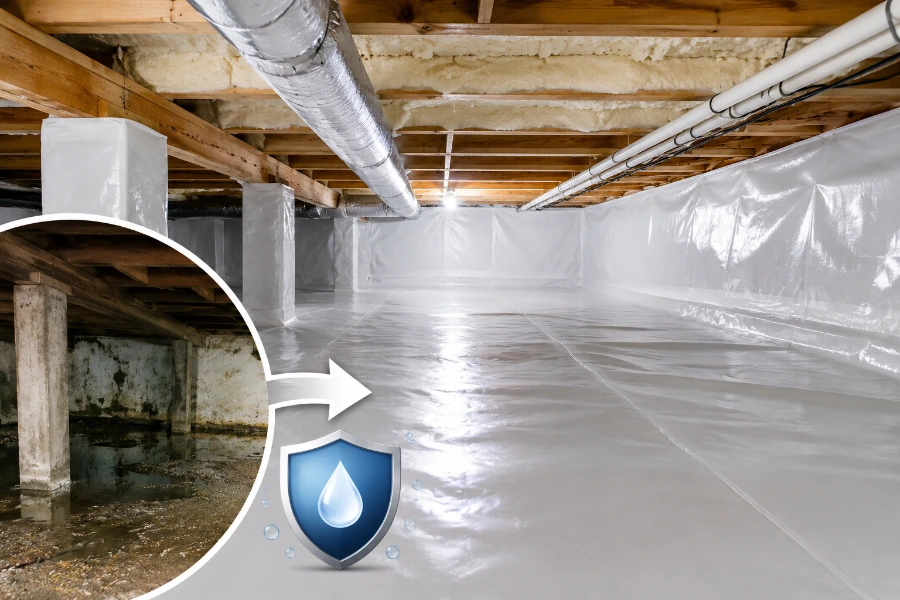
Ground vapor barrier
A heavy-duty (typically 12–20 mil) reinforced polyethylene liner across the entire ground surface, sealed at seams and run up the piers and walls, not just draped over the dirt.
Closed-cell foam on walls
Sprayed directly on the foundation walls and rim joist. This is where spray foam earns its place over a plastic wall liner alone — it air-seals and insulates the perimeter in one step and won’t sag or come loose over time.
Vent closure
Foundation vents get sealed or mechanically closed. An encapsulated crawl space is meant to stop exchanging air with the outside — leaving vents open defeats the whole job.
Dehumidification
A sealed crawl space still needs somewhere for residual moisture to go. A dedicated crawl space dehumidifier is standard on most jobs and is what keeps humidity in check year-round, not just after install.
Drainage, if needed
If there’s standing water or a high water table, a perimeter drain and sump pump go in before the vapor barrier. Sealing water in is worse than leaving it vented — drainage has to be solved first.
Sealed crawl door
The access door or hatch gets weatherstripped or replaced with an insulated, sealed unit — otherwise it’s a permanent air leak into an otherwise sealed space.
Closed-cell foam walls vs. a vapor barrier alone
For a neutral overview, see the U.S. Department of Energy’s guide to types of insulation.
Some crawl space companies sell encapsulation without foaming the walls — just the ground liner and a dehumidifier. That’s cheaper, and it’s better than a vented crawl space, but it leaves the foundation walls and rim joist as an uninsulated, unsealed boundary. Air still leaks in around the sill plate, and the walls themselves can still sweat in summer.
| Vapor barrier only | Vapor barrier + closed-cell foam walls | |
|---|---|---|
| Ground moisture | Blocked | Blocked |
| Wall air leakage | Not addressed | Sealed |
| Wall condensation risk | Still possible | Eliminated |
| Adds R-value | No | Yes, at the perimeter |
| Relative cost | Lower | Higher, but usually the more permanent fix |
Ask for a quote both ways so you can see which your house needs. If the walls are dry, well above grade, and the ground moisture is the whole problem, a liner-and-dehumidifier package may be all you need.
Signs your crawl space needs this
One or two of these doesn’t necessarily mean a full encapsulation job — but several together, especially visible mold or standing water, mean it’s worth a professional estimate before it gets into the structure.
What crawl space encapsulation costs in Arkansas
Square footage, wall height, moisture severity, and whether drainage is needed are what move your number.
Varies by job — get a free written estimate
Liner + dehumidifier only
Varies by job — get a free written estimate
Full encapsulation + foam walls
Varies by job — get a free written estimate
Drainage + sump pump
Be cautious of a quote dramatically below these ranges — thin liner material, unsealed seams, or foam sprayed too thin all fail the same way: quietly, over a couple of years, after you’ve already paid for it. For our full statewide cost breakdown across all foam services, see the spray foam insulation guide.
Where encapsulation can go wrong
Sealing in water instead of solving it
If there’s an active water source — poor grading, a downspout dumping next to the foundation, a high water table — sealing the space without fixing drainage first traps the problem instead of solving it. A good contractor checks for this on the estimate and won’t encapsulate over a wet space without addressing the water first.
Termite bonds, same as the attic
Foam over the sill plate and foundation wall can hide termite activity from a visual inspection, and if you carry a termite bond, that matters. Call your pest provider before encapsulating. Partner contractors can leave an inspection gap at the sill on request — mention it if you have a bond in place.
A dehumidifier isn’t optional
Some cut-rate quotes skip the dehumidifier to hit a lower price. Without one, residual humidity from concrete, plumbing, or minor seam leaks has nowhere to go, and it slowly builds back up. It’s not an upsell — it’s what keeps the job working five years from now.
Existing mold has to be remediated, not just covered
If there’s active mold on joists or subfloor, encapsulation on its own doesn’t remove it — it just stops new growth. Significant existing mold needs remediation first. Your contractor should tell you if that’s the case rather than sealing over a problem.
How the work actually goes
- Free estimate. A partner contractor checks for standing water, existing mold, wall condition, and termite bond status, then quotes liner-only or full encapsulation with foam walls.
- Cleanout and prep. Debris, old insulation, and any remaining vapor barrier removed. Standing water and drainage addressed first if needed.
- Foam and liner installation. Closed-cell foam sprayed to the walls and rim joist, then the ground liner installed and sealed at every seam and pier.
- Vents, door, and dehumidifier. Foundation vents closed, crawl door sealed, dehumidifier installed and set.
- Walkthrough. The contractor shows you the finished space and confirms everything’s sealed.
Common questions
Worried about mold, water, or a termite bond? Mention it when you request your estimate.
Get a written crawl space estimate
Free estimates across Arkansas. A partner contractor will check for water and mold and tell you plainly what your crawl space actually needs — not the most expensive package.