
Crawl Space Spray Foam Insulation in Arkansas
Closed-cell foam sprayed on the rim joist, band joist, and foundation walls — the part of the crawl space job that actually stops the heat loss, air leaks, and moisture that fiberglass batts can’t touch.
The short answer
Crawl space spray foam means closed-cell foam sprayed directly on the rim joist, band joist, and foundation walls — not blown into the floor above, and not just a plastic liner on the ground. It runs 2-lb density, about R-6.5–7 per inch, and does double duty as an air seal and a vapor barrier in one pass. Rim joist spray foam averages $2,000–$2,500 nationally (HomeGuide, Dec 2025). Most Arkansas crawl spaces get both, plus a ground vapor barrier, as part of a full crawl space encapsulation. National average, not a quote — get a free written estimate from a partner contractor.
That’s the summary. Below is why the rim joist matters more than most homeowners realize, what closed-cell foam does that a liner alone doesn’t, real costs, and where this fits next to full encapsulation.
Why the rim joist and band joist matter more than the floor
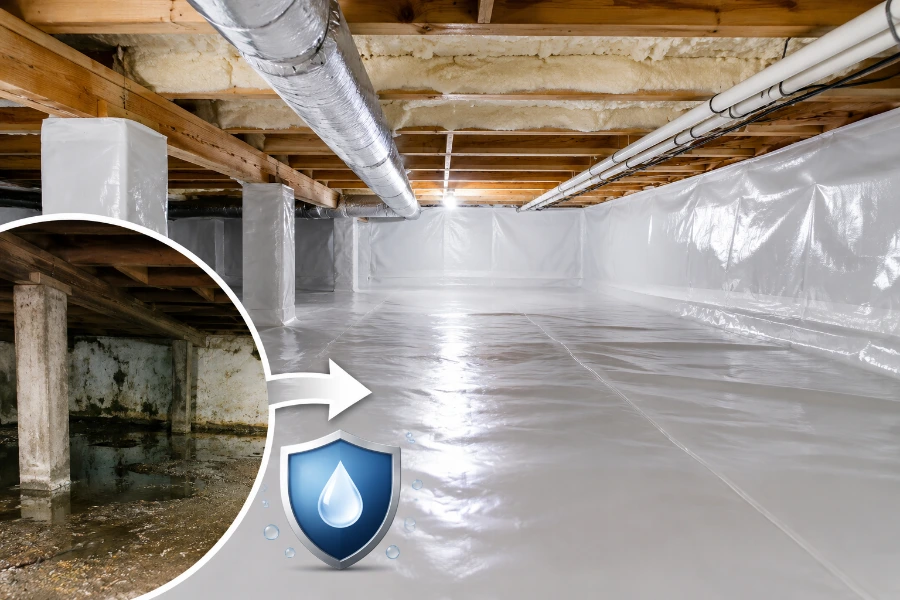
The rim joist (also called the band joist) is the horizontal framing member that caps the ends of your floor joists and sits directly on top of the foundation wall — it’s the band running around the entire perimeter of the house where the wood framing meets masonry. It’s also one of the leakiest, least-insulated parts of most Arkansas homes, and almost nobody thinks about it because you can’t see it from inside the house.
Older homes typically have nothing there but a thin strip of fiberglass batt, if that — and batts don’t seal to irregular framing, so outside air moves freely through every gap. That’s cold floors near exterior walls in winter, and it’s a direct path for humid outside air in summer, which is exactly what feeds condensation once it hits cooler framing. Spraying closed-cell foam directly onto the rim joist fills every gap around joist bays, sill plates, and sistered framing in one pass — something a batt or a rigid foam board cut-and-cobbled in by hand can’t match.
If you only do one thing in a crawl space, the rim joist and band joist is usually it — it’s the highest air-leakage-per-dollar fix down there.
Why closed-cell foam is the right call for crawl space walls
For a neutral overview, see the U.S. Department of Energy’s guide to types of insulation.
Open-cell foam is the right choice for an attic roofline or an interior wall, but a crawl space is a different environment — it sits against soil, concrete, and ground moisture, and it needs a material that can handle occasional dampness without absorbing it. Closed-cell foam is a semi-permeable vapor barrier on its own, at 2-lb density and R-6.5–7 per inch, meaning it does the vapor-blocking job a liner does, plus air sealing, plus insulation, in the same layer — and it won’t wick water the way open-cell can.
| Open-cell foam | Closed-cell foam | |
|---|---|---|
| Density | ½-lb | 2-lb |
| R-value per inch | ~3.7 | ~6.5–7 |
| Moisture resistance | Absorbs water | Resists water |
| Vapor barrier on its own | No | Yes, at sufficient thickness |
| Structural rigidity | Minimal | Adds rack strength to framing |
| Best fit here | Not recommended for crawl space walls | Rim joist, band joist, foundation walls |
See our full closed-cell spray foam page for the deeper material comparison, or the open-cell page for where that product belongs instead.
What’s included in a crawl space spray foam job
Rim joist & band joist
Closed-cell foam sprayed into every joist bay around the perimeter, sealing framing gaps a batt can’t reach.
Foundation walls
Foam sprayed to code-thickness on the interior face of the foundation, insulating and sealing in one layer.
Sill plate sealing
The wood-to-masonry transition where most uncontrolled air leakage happens, sealed as part of the rim joist pass.
Ignition barrier, if exposed
Code-required thermal or ignition barrier coating where foam is left exposed in the crawl space, not buried in the quote.
Spray foam alone vs. full crawl space encapsulation
Spray foam on the rim joist and walls is one piece of the job, not the whole thing. It insulates and air-seals the framing and foundation, but it doesn’t address ground moisture rising up through a dirt floor, or set up a dehumidifier for long-term humidity control. Some homes only need the foam — a dry crawl space with a decent existing vapor barrier can often get by with just a rim joist and wall foam upgrade. Homes with visible ground moisture, a musty smell, or an unsealed dirt floor need the full package.
| Rim joist + wall foam only | Full encapsulation | |
|---|---|---|
| Air leakage at rim joist | Sealed | Sealed |
| Wall insulation & vapor resistance | Yes | Yes |
| Ground moisture | Not addressed | Blocked with vapor barrier |
| Long-term humidity control | Not included | Dehumidifier included |
| Best fit | Dry floor, existing liner in decent shape | Musty smell, visible moisture, no liner |
Your free estimate should spell out which one your crawl space needs. If you’re already seeing mold, standing water, or a musty smell in the house, start with the full encapsulation page instead — that’s the complete moisture-control system, with this foam work as one part of it.
What crawl space spray foam costs in Arkansas
Square footage, wall height, and whether you need rim joist only or full walls are what move your number.
| Scope | Typical range |
|---|---|
| Rim joist & band joist only (average house) | Varies by job — get a free written estimate |
| Foundation walls only (~1,000–1,500 sq ft) | Varies by job — get a free written estimate |
| Rim joist + walls combined | Varies by job — get a free written estimate |
| Rim joist + walls + full encapsulation package | Varies by job — get a free written estimate |
For the full statewide pricing breakdown across every foam project type, see our 2026 cost guide.
Where it can go wrong
Rim joist and wall foam work is usually straightforward, but a few things matter and a rushed installer won’t always bring them up.
Common questions
Not sure if you need rim joist only or the full package? Estimates are free.
Get a real number for your crawl space
Free estimates across Arkansas. A partner contractor will check the rim joist, band joist, and walls, and tell you plainly whether you need spray foam alone or full encapsulation.